


The Laboratory for Viral Immunotherapy of Cancer (VIT Lab) conducts research on the preclinical development of novel virus-based cancer therapies and provides scientific support for early clinical phase-I trials. To achieve this, we use viruses that infect and kill tumor cells but spare healthy tissue given certain conditions. These viruses have direct tumor-inhibiting effects, which can be further enhanced through extensive molecular modifications (for example as cancer vaccines or as gene vectors).
Mission

Research
In recent years, immunotherapy has established itself as a promising treatment option for various types of cancer. By specifically activating the patient’s own immune system, it can recognize and attack abnormal cells such as cancer cells. However, many tumors often remain undetected by the immune system, often limiting the efficacy of current immunotherapies.
Here, oncolytic (cancer-killing) virotherapy comes into play. We use a virus from the animal kingdom, the vesicular stomatitis virus (VSV), which can infect, replicate in and lyse human tumor cells. This tumor infection triggers a very strong immune response, thereby increasing the likelihood that the immune system will recognize the tumor itself.
This is precisely the focus of our research. Through a variety of projects, we aim to establish the scientific foundations for the development of future virus-based immunotherapies.
- Modulation of cancer cell death
Cells can die in different ways, and certain viruses trigger a type of cell death that only weakly activates the immune system. Through various genetic modifications we are trying to induce other modalities of cell death in cancer cells. This could help the body’s own immune system learn how to fight cancer more effectively, potentially leading to better treatment outcomes, or even a complete cure.
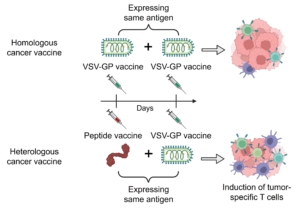
- Cancer vaccination
Therapeutic cancer vaccines are designed to help the immune system recognize and fight existing cancer cells. To achieve this, specific tumor markers, known as tumor antigens, are introduced in order to “train” the immune system. Various platforms can be used to deliver these antigens, including protein fragments, DNA or RNA, or specifically engineered viruses. We incorporate such tumor antigens into VSV-GP, thereby turning it into virus-based cancer vaccine that can simultaneously infect tumor cells. However, tumors often develop mechanisms to evade immune recognition. To overcome these challenges, we investigate various strategies to enhance vaccine efficacy, for example through combination vaccination approaches.
- Interplay of oncolytic virus and the tumor microenvironment
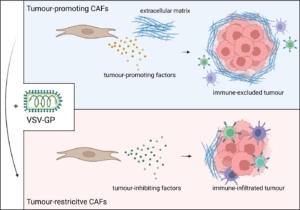
An important part of cancer treatment is understanding the area around the tumor, known as the tumor microenvironment (TME). This includes cancer-associated fibroblasts (CAFs) amongst other cells. These CAFs contribute to tumor growth by changing the surrounding tissue and stopping the immune system from attacking the tumor. This makes it harder for immune cells to target the tumor effectively. Viral immunotherapy is also affected by CAFs, however, CAFs have also been shown in some cases to help limit tumor growth. Our aim is to use an oncolytic virus (VSV-GP) to modify CAFs from tumor helpers to tumor inhibitors. By doing this, we hope to make viral immunotherapy more effective.
- Analyzing immune system activation in clinical virotherapy studies
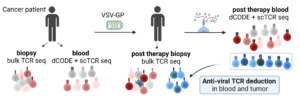
Changes in the T cell receptor (TCR) repertoire are important for tracking how the immune system responds to immunotherapy. Currently, the most common way to study TCRs in clinical trials is through bulk sequencing, which analyzes many T cells together. However, when using an oncolytic virus (OV) like VSV-GP, the treatment agent itself triggers a strong immune response. This leads to an increase in virus-fighting T cells, which can make it harder to accurately assess the overall TCR repertoire.
This project aims to solve that problem by using single-cell TCR sequencing, which allows for a more detailed look at individual T cells. The goal is to identify and remove antiviral TCRs from the dataset to get a clearer picture of the immune response to cancer. This new method is currently applied in a sub-study of a clinical trial for VSV-GP. Ultimately, it will help better understand how CD8+ T cells change during VSV-GP treatment.
Research Team Members












Alina Nessensohn, BSc
Master Student
OUR AIM IS TO FURTHER COMPREHEND THE MOLECULAR FACTORS BEHIND THE ONSET OF CANCER.
Publications
Selected Publications
- Hofer T., Pipperger L., Danklmaier S., Das K. & Wollmann G. Characterization of the Anti-Viral and Vaccine-Specific CD8+ T Cell Composition upon Treatment with the Cancer Vaccine VSV-GP. Vaccines (Basel), 12(8):867. (2024).
- Vijver S. V., Danklmaier S., Pipperger L., Gronauer R., Floriani G., Hackl H., Das K. & Wollmann G. Prediction and validation of murine MHC class I epitopes of the recombinant virus VSV-GP. Front Immunol., 13:1100730. (2023).
- Hofer T., Rossi M., Carboni S., Di Berardino Besson W., von Laer D., Wollmann G., Derouazi M. & Santiago-Raber M. L. Heterologous Prime-Boost Vaccination with a Peptide-Based Vaccine and Viral Vector Reshapes Dendritic Cell, CD4+ and CD8+ T Cell Phenotypes to Improve the Antitumor Therapeutic Effect. Cancers (Basel), 13(23):6107. (2021).
- Das K., Belnoue E., Rossi M., Hofer T., Danklmaier S., Nolden T., Schreiber L. M., Angerer K., Kimpel J., Hoegler S., Spiesschaert B., Kenner L., von Laer D., Elbers K., Derouazi M., Wollmann G. A modular self-adjuvanting cancer vaccine combined with an oncolytic vaccine induces potent antitumor immunity. Nat Commun., 12(1):5195. (2021).
- Schreiber L. M., Urbiola C., Das K., Spiesschaert B., Kimpel J., Heinemann F., Stierstorfer B., Müller P., Petersson M., Erlmann P., von Laer D., Wollmann G. The lytic activity of VSV-GP treatment dominates the therapeutic effects in a syngeneic model of lung cancer. Br J Cancer, 121(8):647-658. (2019).